Some parts can’t be made on just any lathe. The tolerances are too tight, and the features are too small to hold on a standard machine. That’s the moment a Swiss turning manufacturer earns its keep. But why Swiss? What makes these machines different from an everyday CNC lathe? The answer comes down to how the cutting tool meets the material, and where the tool sits while cutting. Here is a look at the process, where it fits best, and what to watch out for. Just the details that matter on the shop floor.
The Core Idea Behind Swiss Turning
Swiss turning flips the usual setup. Instead of the part spinning while tools travel toward it, the bar stock feeds through a guide bushing. The tools stay put. That single change fixes turning’s oldest problem: deflection. On a normal lathe, a long thin part pushes away from the tool. Accuracy suffers and surface finish turns ugly. The bushing holds the work steady right where the insert meets metal. There is almost no room to flex. So size and finish hold on parts that would wobble elsewhere. Most Swiss machines also carry live tools for milling, drilling, and tapping. That means a part can leave the machine finished, not half-done. The result is true CNC Swiss turning: precise, repeatable, and fast. This is the foundation every Swiss screw machining shop builds on.
Why the Accuracy Holds
Tolerances on these machines can run into a few microns, which is especially important for small-diameter components where Swiss CNC machining improves tolerance control in micro-components. On small diameters, that’s often tighter than the drawing even requires. Hit it anyway, and assembly goes smoothly. Heat is a quiet enemy. As a machine runs, thermal growth slowly shifts the tool and the work. Builders fight it with coolant, rigid frames, and tight thermal control. Tool pressure matters too. Light, controlled cuts keep the part from pushing back. That’s why a feature often gets finished in one pass, which saves time and tool life.
Where Swiss Turning Beats Other Processes
That advantage shows up on specific jobs where the geometry is unforgiving, the volumes are real, and mistakes get expensive.
- Small-diameter work — parts under roughly 32 mm are the sweet spot. Bar stock feeds straight through a guide bushing, so tiny screws, bushings, and contact pins come out by the millions with almost no variation.
- Long, slender geometry — medical guidewires, needles, and probe shafts stay straight because support sits right at the cut, not inches behind it where flex creeps in. A standard lathe would scrap them.
- Complex, multi-feature parts — cross-holes, threads, slots, and chamfers get cut in a single setup. The part never moves, so it never loses position, and fewer setups mean fewer chances for a fixture error.
- High volume with tight control — bar feeders and simultaneous tooling keep cycle times short. Thousands of identical parts arrive without an operator standing over the machine all night.
- Secondary work in the same cycle — the subspindle picks off the finished part and machines the back side. No second trip, no re-chucking, no lost concentricity.
- Tough alloys — the metals that fight back cut cleanly when the cut stays rigid. That rigidity is exactly what a sliding-headstock machine delivers on every pass. Soft material is easy; hard material exposes a weak setup fast.
Materials and Industries
Medical, aerospace, defense, and semiconductor buyers all rely on Swiss machines. Their parts share one trait: tiny size and zero tolerance for error. Titanium, Inconel, stainless, and PEEK all show up on a normal week. Nobody runs one alloy forever, so flexibility matters. Some alloys are gummy. Some are abrasive. Some work-harden the second the tool dwells in one spot. Rigidity helps, but the wrong feed rate still ruins the cut. That is why high-precision components for regulated industries rarely get made another way. A few microns off can scrap an implant or sideline an aircraft part.
What to Look For in a Partner
Once the process fits, the supplier matters just as much, so check these few things before you commit to anyone.
- Axis count and channels — a single 9-axis, 3-channel machine can replace several simpler lathes. More axes mean more work finished in one pass, and for complex parts that shows up in the price.
- Lights-out capacity — bar feeders and in-process gauging let machines run unattended overnight. That keeps lead times short without adding a second shift, and it lowers cost per part on long runs.
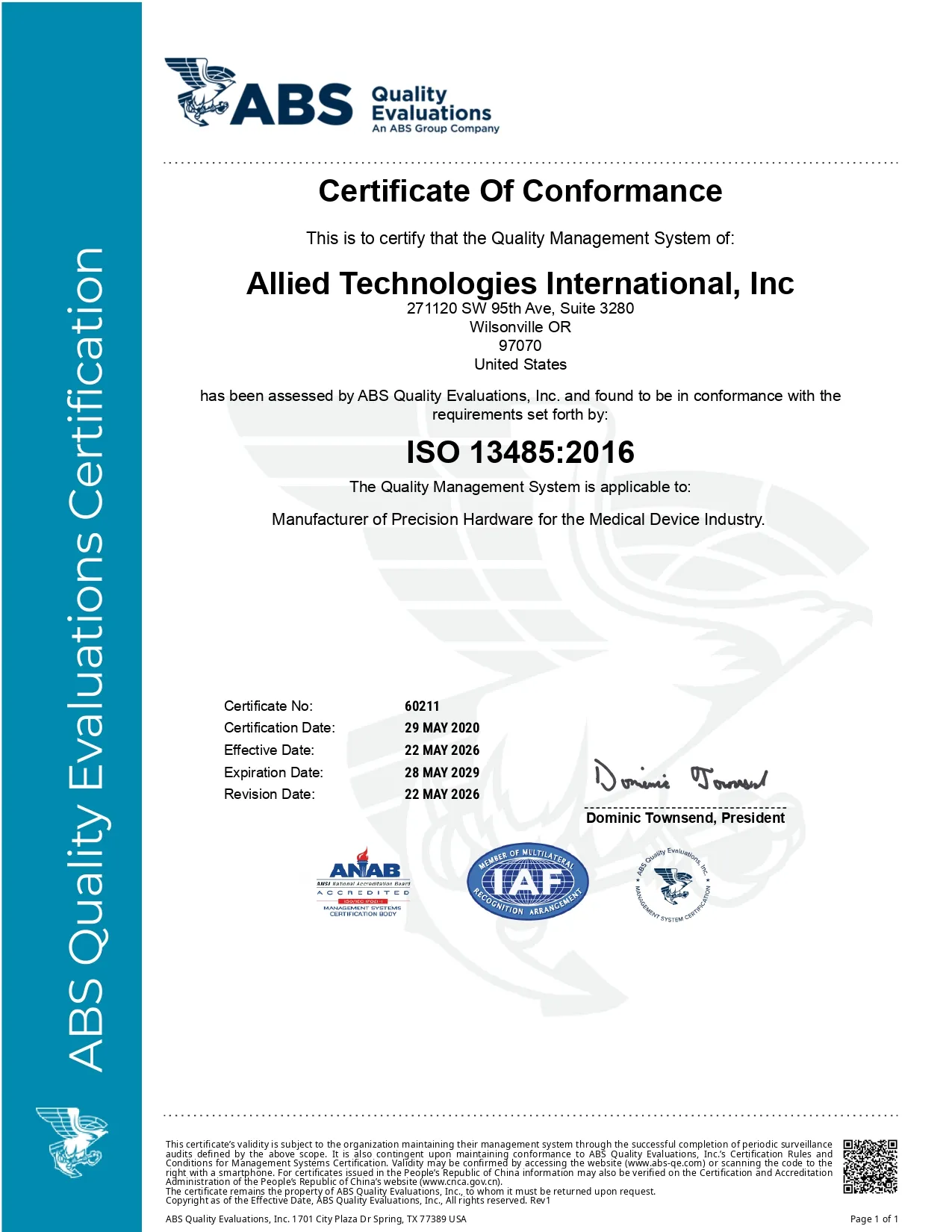
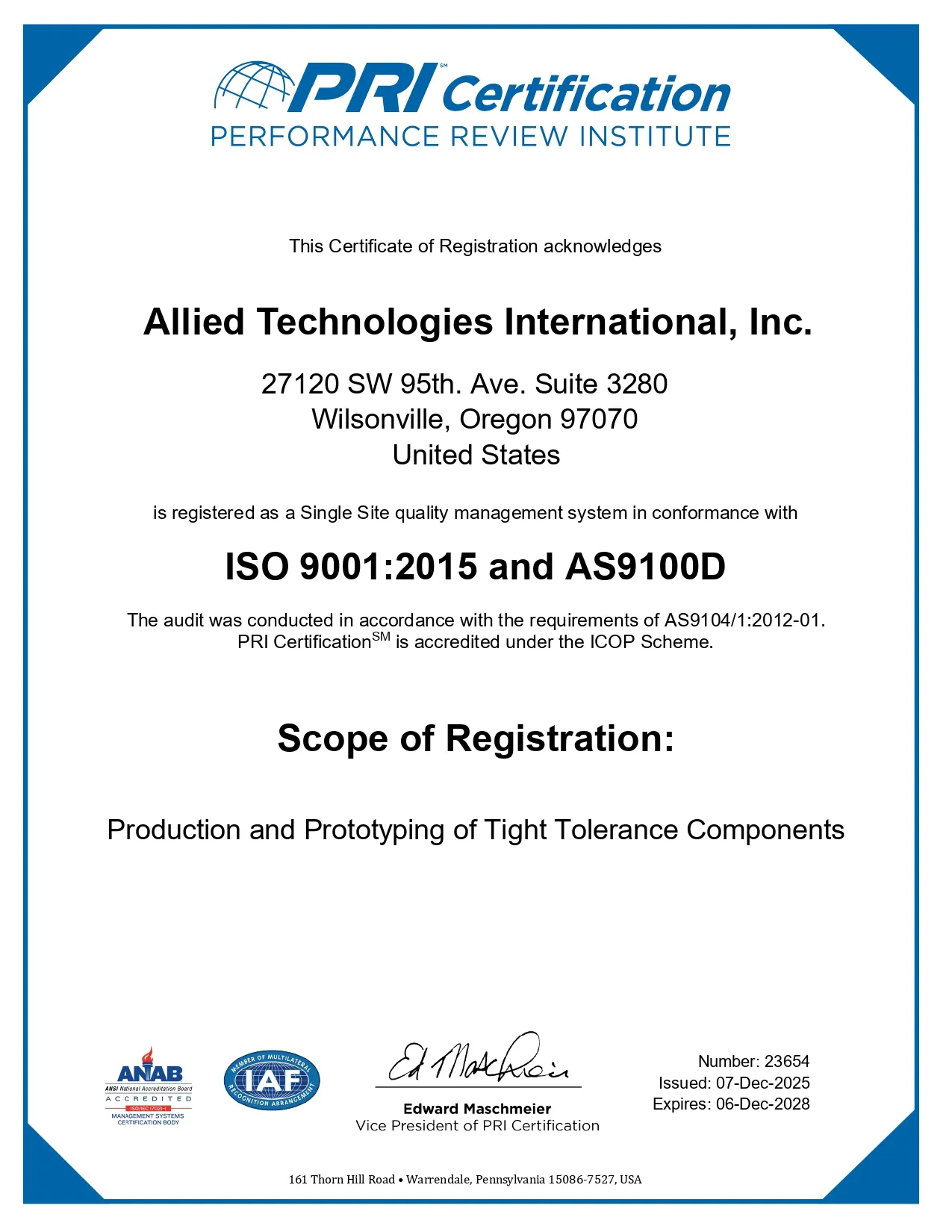
- Certifications that mean something — AS9100D, ISO 13485, and ITAR registration are not just paperwork. They prove a shop can trace material, control changes, and handle defense work legally. If a supplier cannot show them, walk away.
- In-house inspection — a CMM and an optical comparator let a shop verify real geometry instead of trusting a dial. That matters when a part is measured in microns, and outsourcing first-article checks only adds delay.
- Experience with hard materials — anyone can turn brass. Titanium, cobalt chrome, and Inconel separate the shops that can from the shops that just talk a good game. Ask what they run most weeks.
- Real capacity data — ask how many spindles they run and how many hours they leave unattended. Vague answers usually mean the shop is smaller than the website claims.
The Honest Trade-offs
Swiss machines are not a cure-all. They are built for small parts. Hand them a big, chunky shaft, and a conventional lathe wins. Setup takes time. Tooling sits close together, so a crash is expensive, and programming needs care. This is not a machine you hand to a beginner. That is not a knock on the process. It is just an honest limit worth knowing before you send out a quote. Picking the right partner matters as much as the process. Strong Swiss CNC machine contract manufacturers combine capacity, traceability, and material knowledge. Ask hard questions about axes, certifications, and defect rates. A straight answer tells you plenty, and a vague one tells you even more. But for the right part, nothing else comes close. That is the honest version of the story, and it is why precision Swiss turning keeps winning in tight industries.
Where Allied Technologies International Fits In
At Allied Technologies International, this is our daily work. As a Swiss turning manufacturer, we machine the small, fussy parts that other shops turn away. Our floor runs 9-axis Swiss turning machines with three channels, plus 3- to 5-axis milling. That mix lets us finish complex geometry in fewer setups. We hold AS9100D and ISO 13485 certifications, we are FDA registered, and we are ITAR compliant. Documented traceability and controlled processes come standard, not as an upsell. If your part demands tight-tolerance machining and a partner who understands the material, we would like to hear from you.
Have a part that keeps getting scrapped at final inspection?
Conclusion
Swiss turning is not magic. It is a machine design that solves one specific problem: cutting small, complex parts without losing accuracy. When the job fits, the advantage is huge. So pick a shop on capability, not price alone. Ask about axes, certifications, and how they handle tough alloys. Then let the process do what it does best. For work where microns decide whether a part passes, choosing the right Swiss turning manufacturer is half the battle. The machine handles the rest.