A bad part wrecks the whole assembly. Missing a blueprint dimension by even a hair turns expensive raw material into useless scrap, stopping production lines completely. Modern factory floors rely on contract precision CNC machining services to eliminate this human error. The process uses automated lathes to spin raw stock while sharp cutting tools continuously shave away excess material. Mastering these physical variables on the shop floor yields perfectly steady part sizes, faster cycle times, and predictable manufacturing costs week after week.
Critical Certifications First: The Baseline for Regulated Industries
For tier-one OEMs in aerospace, defense, and medical device manufacturing, technical capability is irrelevant without the corresponding paperwork. The entry point for complex assemblies requires a machining partner with robust quality management systems:
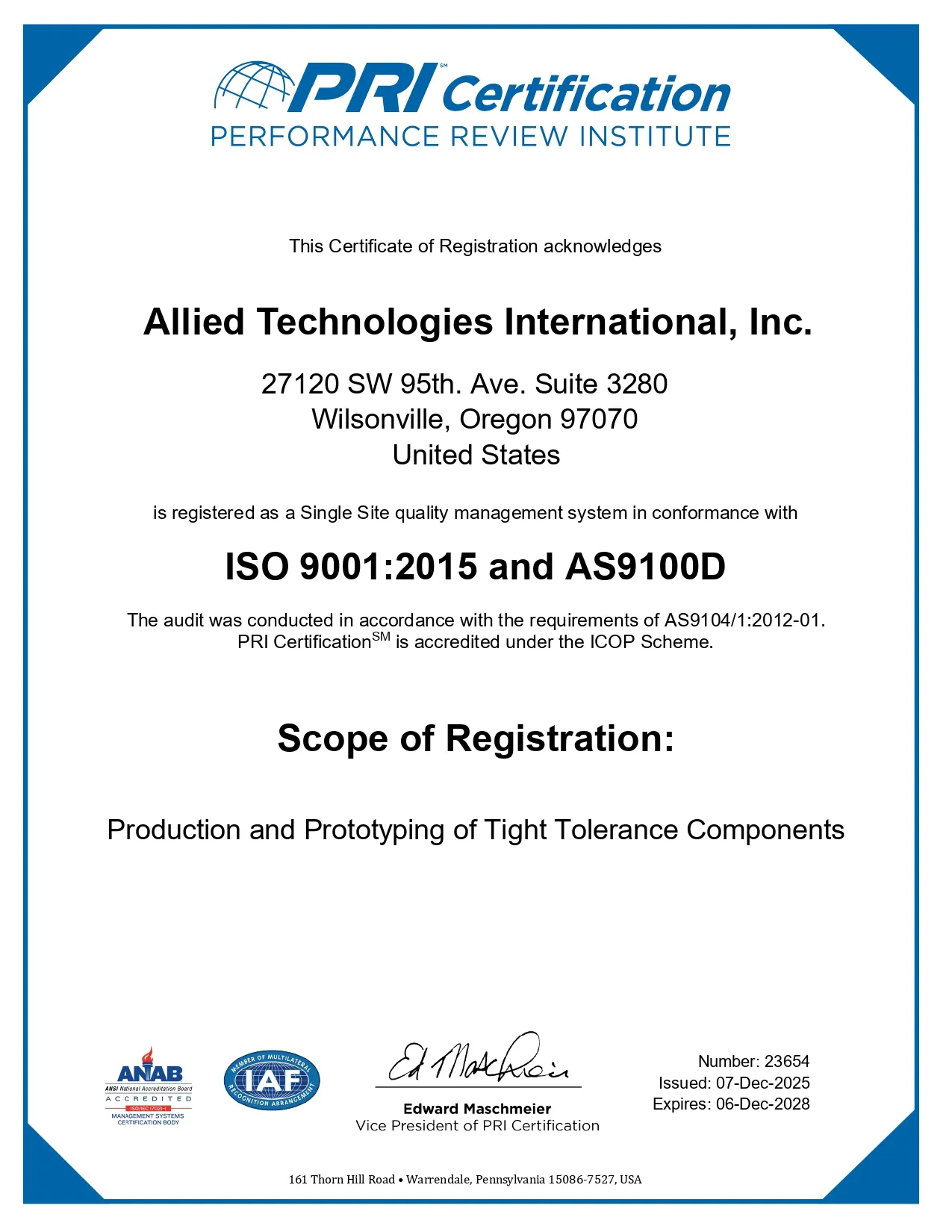
- Aerospace & Defense: Strict adherence to AS9100D ensuring complete lot traceability, counterfeit part prevention, and rigorous configuration management.
- Medical Devices: ISO 13485 certification and FDA registration to maintain rigid production validation, process consistency, and cleanliness for surgical instrumentation and implants.
- National Security: ITAR compliance to handle sensitive defense-related structural and electronic configurations legally.
Dimensional Repeatability: Structural Accuracy Under Load
Modern CNC turning manufacturing centers maintain strict tolerances through automated electro-mechanical feedback loops rather than manual operator oversight. Learn how CNC precision turning can improve part performance, consistency, and reliability. Linear scales and high-resolution servo loops constantly compare the actual physical position of the tool to the commanded coordinates, executing micro-adjustments thousands of times per second.
Eliminating Thermal Drift
As spindles and ball screws heat up during long production runs, friction induces physical material expansion. Industrial machine shops actively counteract this dimensional creep by running specialized thermal warm-up routines prior to the first production cut, ensuring the machinery achieves physical equilibrium before running production stock.
Real-Time Tool-Wear Compensation
Cutting edges naturally degrade over time. Instead of requiring manual adjustment via dials, modern CNC controllers track tool usage data and automatically update macro coordinate offsets. This ensures part 5,000 mirrors the exact dimensional profile of part 1 without pausing the assembly line.
Optimizing Production Logistics and Part Cycle Times
Maximizing efficiency in CNC lathe machining depends heavily on minimizing secondary handling and keeping cutting tools engaged with raw stock.
Multi-Axis Machine-Level Efficiency
- Multi-Channel Control: Enables two or three independent cutting tools to machine separate geometric features on a single workpiece at the exact same time.
- B-Axis Live Tooling: Integrates milling, cross-drilling, flatting, and slotting operations within the lathe setup, entirely removing the need for a secondary milling fixture.
- Pick-Off Subspindles: Automatically grabs the component during production to machine the back face, outputting a finished part straight from the machine enclosure.
Process Automation & Material Flow
- Automated Bar Loaders: Continuously feed long bar stock into the spindle collet, allowing for uninterrupted, unattended “lights-out” manufacturing overnight or weekends.
- High-Pressure Coolant Delivery: Blasts specialized fluid directly at the cutting zone, evacuating chips immediately to prevent recutting debris and preserving edge life.
- Offline Tool Presetting: Utilizes external optical presetter units to calculate and verify exact tool geometry offsets before an operator ever places the toolholder inside the machine envelope.
Managing Complex and High-Deflection Geometries
Managing Complex and High-Deflection Geometries
Standard turning setups encounter issues when processing slender parts; pushing a long tool against a narrow rod forces the material to bow away, resulting in severe taper flaws and tool vibration. For long, thin profiles, Swiss style CNC machining alters the mechanics. Instead of holding a static bar out in open space, a Swiss lathe feeds the raw material forward through a highly precise guide bushing, keeping the tool cutting fractions of a millimeter away from the structural support point. This setup eliminates part deflection on length-to-diameter ratios stretching past 10:1.
Geometric Capabilities Overview
Deep-Bore Cavity Profiles
- Machining Mechanism: Rigid, internal boring bars paired with high-pressure fluid delivery.
- Operational Result: Prevents chip packing and tool breakage inside blind holes.
Thin-Walled Components
- Machining Mechanism: Synchronized feed rates and balanced, light-pressure chucking.
- Operational Result: Prevents radial distortion and egging during outer-diameter profiling.
Micro-Feature Generation
- Machining Mechanism: Ultra-high rpm spindles paired with micro-grain carbide tools.
- Operational Result: Safely generates micro-grooves and pins below 0.5 mm in size.
Machining High-Strength and Temperature-Resistant Materials
When dealing with demanding aerospace or medical components, selecting the correct material is only half the battle; the production floor must also know how to cut it without destroying tooling.
Titanium & Inconel
These superalloys possess minimal thermal conductivity, meaning intense friction heat stays concentrated directly on the cutting edge instead of exiting inside the metal chip. Machining these metals successfully requires running rigid structural tool-path setups, low surface footages, and highly specific grades of premium coated carbide.
Coating Technologies
Advanced coatings like Aluminum Titanium Nitride (AlTiN) provide an insulating thermal barrier that actively protects the underlying carbide tool core from breaking down when cutting temperatures climb past critical thresholds.
Engineering Plastics (PEEK / Delrin)
Unlike metals, polymers feature high coefficients of thermal expansion. If a part heats up during processing, it will measure correctly inside the machine enclosure but shrink out of tolerance once it cools down on the inspection table. Shops resolve this by applying razor-sharp cutting geometries and light chip loads to keep friction low.
Financial Impacts: Shifting Beyond the Unit Price
The true cost of a precision turned component is rarely found on the initial line-item invoice. A comprehensive budget assessment must account for the operational expenses driven by processing variances, scrap rates, inspection latency, and downstream assembly line delays. Opting for highly stable, automated manufacturing workflows protects your bottom line by systematically reducing these hidden financial drains. When a machine center reliably holds its dimensions across thousands of consecutive pieces, companies can significantly reduce manual sorting, streamline incoming quality control inspections, and keep downstream assembly lines running on schedule.
Partner with Allied Technologies International
We run a specialized contract manufacturing facility in Wilsonville, Oregon. Our shop floor focuses entirely on high-precision Swiss machining and multi-axis turning cells. Our machinists routinely cut challenging materials like Titanium, Inconel, and PEEK. We use these capabilities to support demanding components for clients across the aerospace, medical, semiconductor, and telecom sectors. Every shipment arrives at your dock with full material traceability and inspection reports. You can submit your part drawings and project requirements directly through the website.