A late shipment of precision parts rarely stays a small problem. It holds up assembly lines, pushes back certification dates, and puts pressure on every team downstream. At Allied Technologies International, we see this often with aerospace, medical, and telecom customers who cannot afford to wait weeks for a prototype or a bridge order. That is why quick turn CNC machining has become a planning tool and not only a rush service. In this guide, we explain where lead time gets lost, how our Swiss and bar-fed processes recover it, and what engineers can do at the design stage to get good parts out the door sooner.
Why Do Lead Times Stretch in CNC Machining Services in the USA?
Most delays have little to do with cutting time. In our experience, the clock runs mostly while a job waits: for a quote, for material, for a fixture, for a first-article approval, or for a second setup on another machine. When buyers of CNC machining services USA are treated like order numbers, those waiting periods pile up quickly. At Allied Technologies International, we map a job from the first drawing to final shipment and look for idle gaps. Common culprits include unclear tolerances that trigger back-and-forth emails, parts that need four or five separate setups, and inspection plans written after the first run instead of before it. Each of these can add days without adding any value to the part.
Want to cut multi-setup delays from your next run?
How Does Swiss Machining Cut Cycle Times?
Swiss-type machines hold the bar stock close to the cutting tool, which keeps long, slender parts steady and cuts vibration. That stability lets us hold tight tolerances at productive speeds, and it protects surface finish on small features that would chatter on a conventional lathe. The bigger time saving comes from consolidation. Our programmable 9-axis, 3-channel machines turn, drill, mill, and thread in a single pass, so a component often leaves the machine finished. No second operation means no transfer between machines, no extra fixture, and no second inspection setup.
This matters most on small, complex parts such as bone screws, connector pins, and precision fasteners. At Allied Technologies International, we rely on Swiss machining for these jobs because one stable setup gives us repeatable quality from the first piece to the last. It also keeps the schedule predictable when order volumes change, which is something production planners value as much as the part itself.
What Does Bar-Fed CNC Machining Add to Speed?
Automatic bar feeding keeps a machine working without someone loading each blank by hand. Once the bar is loaded, the machine cuts parts off and feeds again on its own. For repeat orders, that steady rhythm removes the small pauses that add up over a long run.
We also use bar-fed CNC machining for lights-out production. Once a program has been proven, our machines can keep running through the night with monitoring in place. A job that would normally take several shifts keeps moving while the day team prepares the next one.
In-process gauging and scheduled inspections stay in the plan, and operators step in whenever a measurement drifts. The result is faster throughput with the same control over dimensions. For customers with urgent bridge orders, that mix of speed and discipline protects both delivery dates and part quality.
How Do High-Performance Engineering Materials Affect Lead Times?
Material choice can quietly set your schedule. That is why high-performance engineering materials deserve a conversation before the order is placed. If bar stock is available in the right grade and size, a job can start quickly. If it needs a special melt or certification, the lead time starts at the mill, not at the machine.
When we plan quick-turn CNC machining at Allied Technologies International, we confirm material availability and certification paperwork on day one. Then we lock in cutting strategies that protect tools and finish. Engineers can help by naming an acceptable alternate grade where the design allows. A small flexibility on material often saves a week.
What Should You Look for in A CNC Machining Manufacturer?
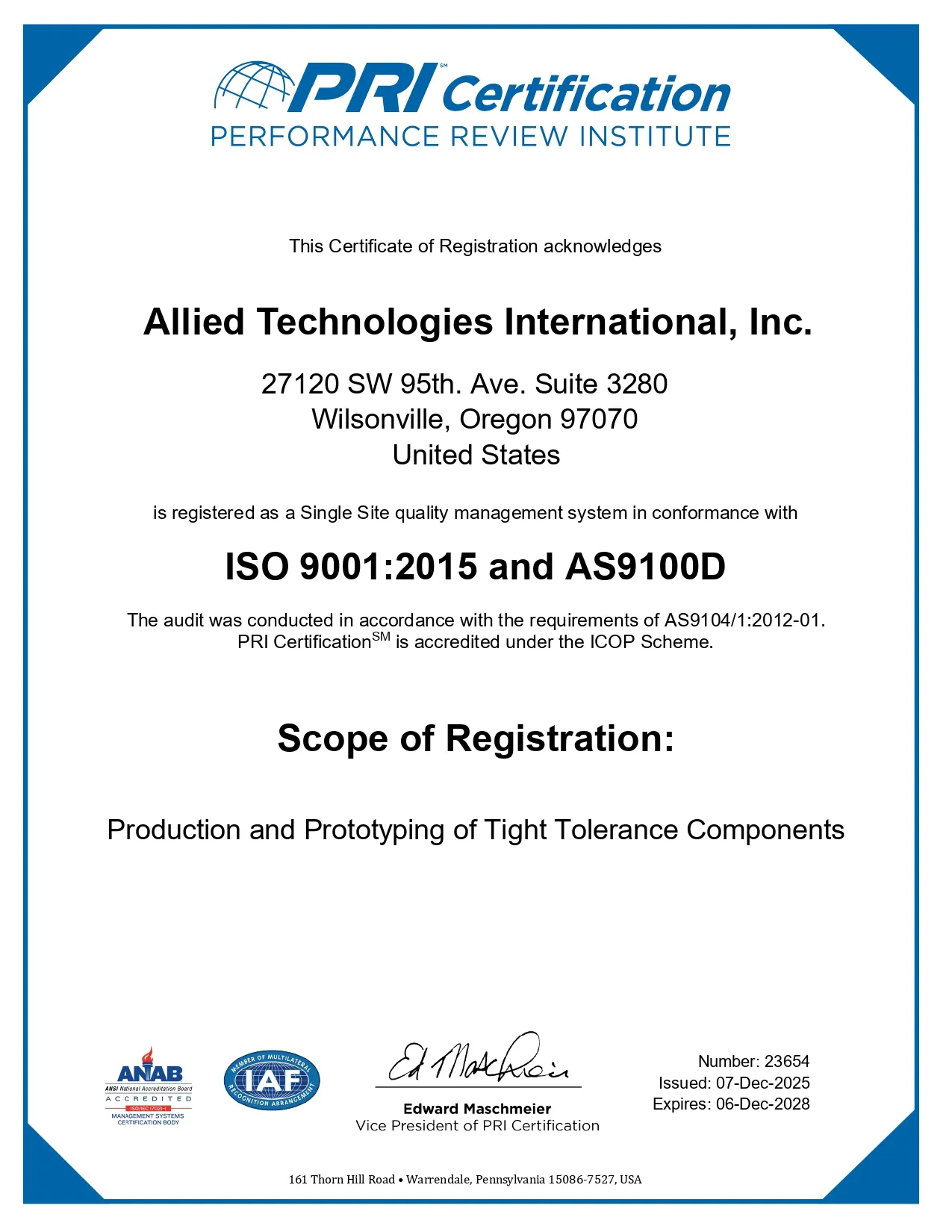
Speed is only useful when the parts are right. When you compare a CNC machining manufacturer USA buyers can choose from, start with certifications and inspection capability. Our Wilsonville, Oregon facility operates with ISO-certified systems and holds AS9100D certification, which gives aerospace and medical customers the documentation they expect.
Then look at the equipment mix. A shop that offers Swiss turning, conventional turning, and 3- and 4-axis milling under one roof can move a part between processes without leaving the building. That saves freight time and keeps one team accountable for the result.
Finally, ask how the shop communicates. At Allied Technologies International, we assign engineers to each program, share design-for-manufacturing feedback with the quote, and update customers when schedules shift. Clear communication is a quiet but powerful lead-time tool, because most surprises in manufacturing come from information that arrived late.
How Does Industrial Component Manufacturing Stay on Schedule?
Predictable delivery comes from process, not heroics. In industrial component manufacturing, a schedule holds when programs, tooling, and inspection plans are ready before the bar is loaded.
We also pair our machining with clear shipping and delivery steps, so finished parts never sit waiting for packaging or paperwork. Engineers can support this by sharing forecasts, even rough ones. When we know what is coming in three months, we can reserve capacity and material, and rush requests become routine instead of stressful.
Need an AS9100D-certified CNC machining partner in the USA?
Contact Us: (503) 691-8999
Why Choose Swiss-style CNC Machining for Faster Delivery?
Shorter lead times come from many small decisions: clean prints, the right material, fewer setups, and a stable process. Quick-turn CNC machining works best when the shop and the engineer make those decisions together, long before the first chip is cut. At Allied Technologies International, Swiss-style CNC machining is the backbone of that approach. One setup, steady support at the cut, and automated bar feeding let us deliver complex, tight-tolerance parts faster without giving up quality. Whether you need a prototype next week or a long-term production program, we are ready to review your drawings and tell you honestly what is possible.