The most critical component in an aerospace assembly is often the one that costs less than a dollar. The fastener. Fasteners rarely receive the attention they deserve. A threaded insert or a captive screw looks simple sitting in a bin, but the engineering behind it is not. Threads distribute load across mating components in ways that most parts never have to, and the margin for error is measured in microns.
Fastener specialties manufacturing has become a proving ground for modern CNC equipment precisely because of that difficulty. A supplier that can hold thread geometry on titanium and Inconel can handle almost anything else.
This article explains what advanced CNC technology actually changes in fastener production, and what buyers should look for when evaluating a supplier.
Why Fasteners Are Harder to Make Than They Look
To the eye, a thread is a groove around a cylinder. To the gage, it is pitch diameter, flank angle, and lead error, each with its own tolerance, and none of the three moves independently.
A part can pass a thread gage and still cause trouble in service, because the error shows up in how the thread seats under load. In fastener specialties manufacturing, a few microns at the thread crest changes how load distributes across the whole joint.
In aerospace and medical assemblies, that is the difference between a part that holds and one that gets rejected at inspection. Good shops check the final dimension, then runout, finish, and tool wear across the batch. Small deviations compound fast.
What Swiss Machining Brings to the Table
Swiss machining is built around a component most people overlook: the guide bushing. It holds the bar stock right at the cutting zone, so the material cannot flex away from the tool.
On a conventional lathe, a long slender fastener bends under cutting pressure, and the thread comes out tapered. Swiss machining removes that problem because the support sits a few millimeters from the tool tip.
That support also means turning, milling, and thread whirling happen in one setup. The part never leaves the machine, so re-fixturing error disappears. Concentricity holds across every operation.
Closed-loop controls work alongside the mechanical support. Cutting force, spindle load, and tool position feed back to the controller, which adjusts the tool path before a part drifts out of tolerance.
Why Repeatability Beats Raw Precision
A machine that hits a tolerance once proves nothing. The parts that matter are the ones at the end of the run, after the spindle has warmed up and the tool has worn a few thousandths.
Thermal growth, tool wear, and material variation push the process off target, each in its own direction. That is why raw precision, impressive on a spec sheet, means less than repeatability, which is what keeps a production line running.
Shops track tool wear compensation, run scheduled corrections, and log the results for every part. The machine that holds the same dimension on part one and part one thousand is worth more than the one that hit the number once and drifted after that.
Materials That Push Machines to Their Limits
- Titanium springs back when cut
- Inconel work-hardens the moment the tool touches it
- PEEK expands with heat and softens without proper coolant control
None of these materials behaves like steel. A program tuned for one will not cut another cleanly. Modern controls let machinists adjust feeds, speeds, and coolant per part instead of trusting the original setup.
Automation and Software: The Quiet Upgrades
The visible side of advanced CNC is the machine itself. The quieter side is the software around it. CAM simulation catches crashes before any metal is cut, and bar feeders keep machines running through breaks.
Robotic cells handle loading and unloading without adding labor hours, while utilization monitoring shows which jobs are profitable and which ones quietly eat time. None of this replaces a skilled machinist, but it gives them better information.
The Precision Turned Parts Manufacturer Advantage
This is where the conversation moves from machine capability to business outcome. A supplier that invests in advanced CNC is not just buying newer equipment. They are buying the ability to hold tighter tolerances, run longer unattended shifts, and document every step for traceability.
That combination matters in regulated industries, where the audit trail is as important as the part itself.
Allied Technologies International: Putting This Into Practice
At Allied Technologies International, we apply these methods every day at our facility in Wilsonville, Oregon.
As a precision turned parts manufacturer, we serve Low Earth Orbit Satellites, Avionics in aerospace, orthopedic implant screws for medical, defense, telecom, and semiconductor customers who expect the same quality from a thousand parts as from the first one.
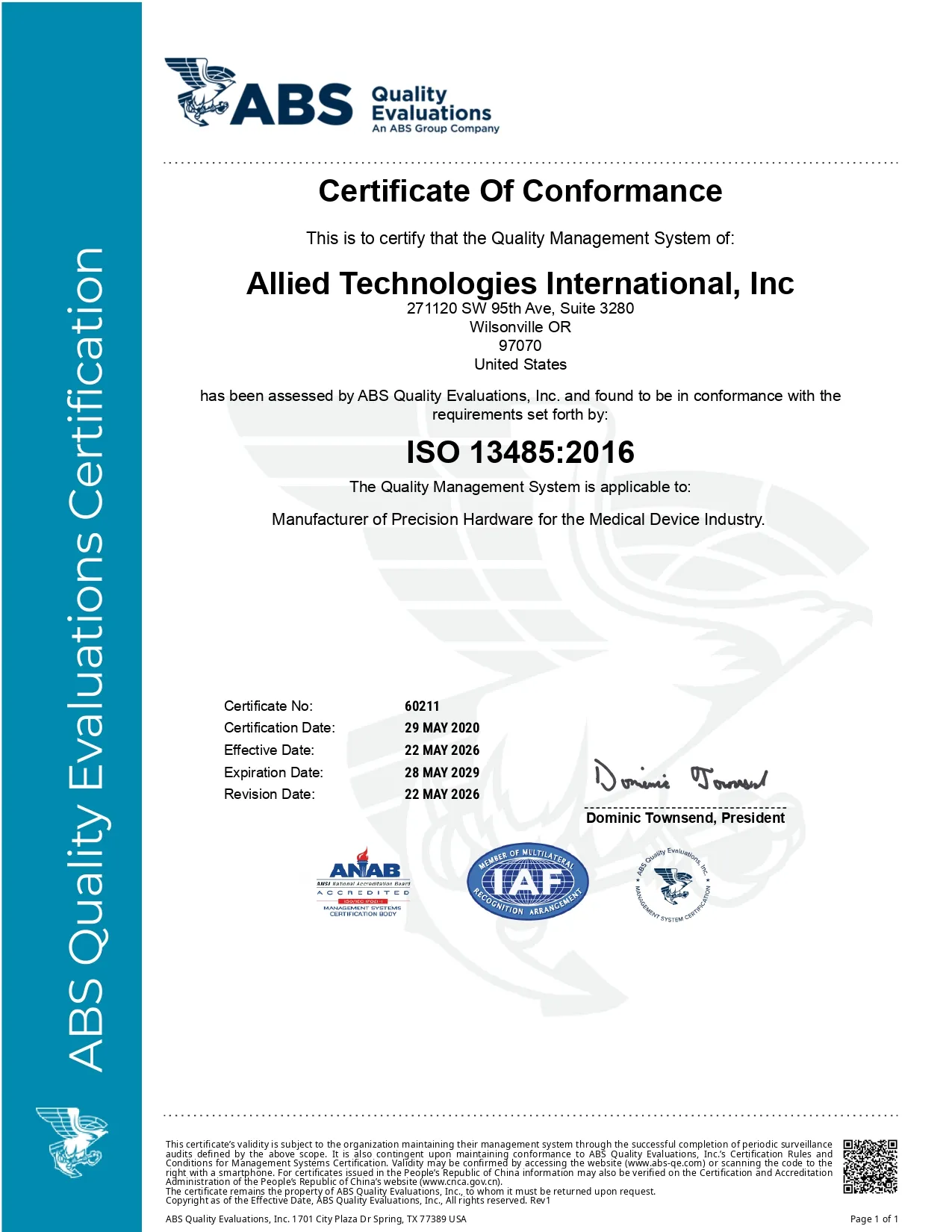
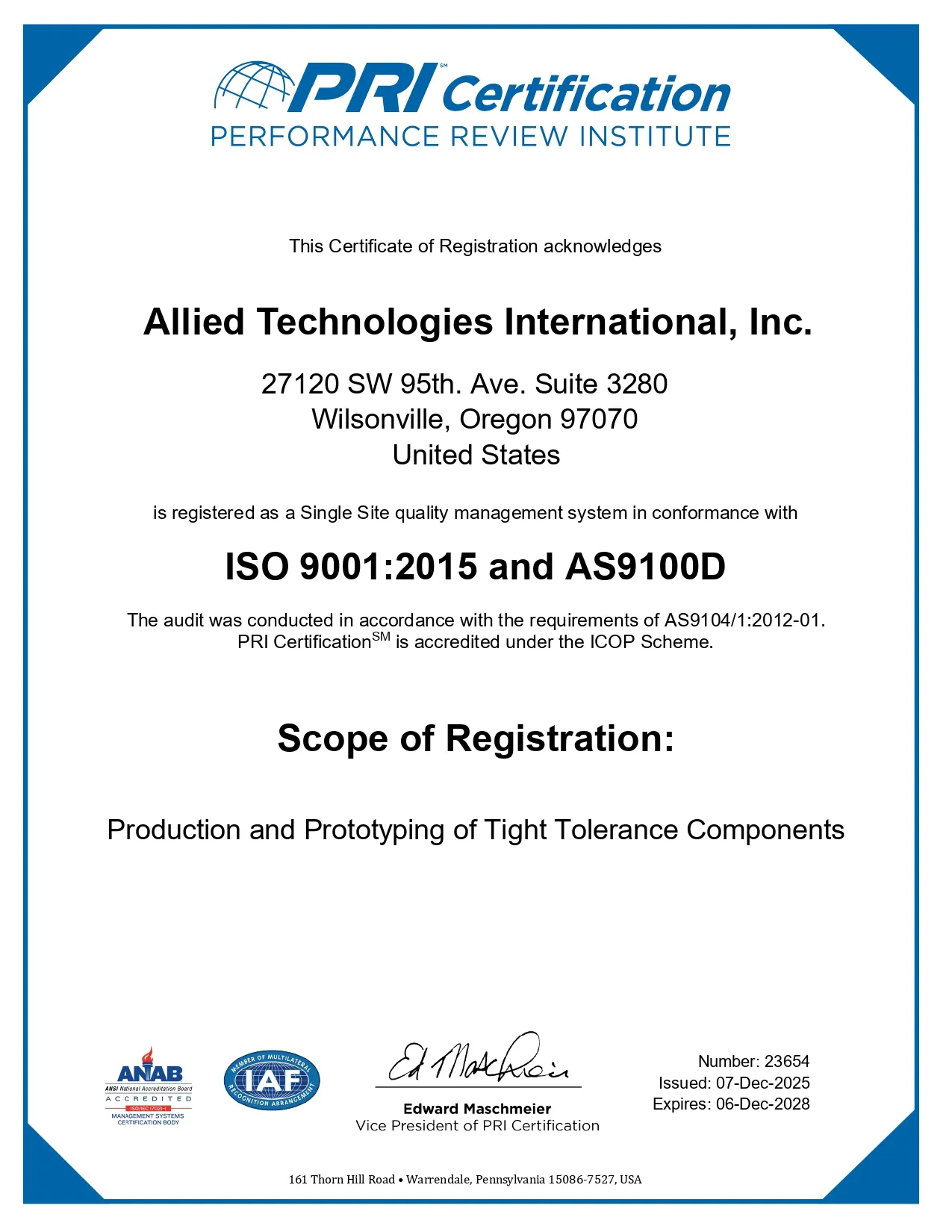
Our Swiss machining capacity is paired with AS9100D and ISO 13485 quality systems, and we are FDA registered and ITAR compliant, so the documentation behind each part is as disciplined as the machine making it.
Want certified precision on every part?
Talk to an Engineer About Your Tolerance Requirements
Conclusion
Advanced CNC technology does not remove the need for good judgment in fastener specialties manufacturing. It removes the guesswork so that good judgment has room to work. The machines are more capable, the software is more honest, and the documentation is more complete. For buyers, the result is simple: parts that fit, thread after thread.