Think about a surgeon holding a tiny bone screw, or an engineer assembling a satellite. A single microscopic flaw ruins the entire project. Standard hardware just won’t cut it. This is where elite manufacturing steps in. When your designs are incredibly complex and impossibly small, traditional machine shops quickly hit a structural wall. Finding high-quality Swiss turned components suppliers is how modern engineering teams bypass these strict production bottlenecks. They deliver the hyper-precise hardware that keeps high-stakes industries running safely.
How Swiss Machining Services Redefine Precision
Traditional lathes spin a metal bar while cutting tools move against it. This sounds fine on paper, but long, thin bars bend and deflect under tool pressure. That slight flex ruins your tight tolerances. Using dedicated Swiss machining services changes the mechanics entirely. Instead of moving the tool along the material, the raw metal bar moves along a Z-axis while staying clamped inside a rigid guide bushing.
The cutting happens within millimeters of this support bushing. Because the raw metal cannot bend or vibrate, the tool makes incredibly clean, stable cuts. It handles complex geometries easily. This setup completely solves the deflection issue. You can machine incredibly thin pins, deep internal bores, and intricate threads without worrying about the metal warping mid-process. It is pure mechanical stability.
Why Advanced Swiss Machining Cuts Out Production Waste
When you are working with expensive alloys, scrap metal eats your profit margins alive. Traditional manufacturing methods often force engineers to buy oversized stock and grind it down. That wastes material. With Swiss machining, you can use raw stock that matches the final outer diameter of your part. The immense stability of the process means you get pristine finishes right off the machine.
There is no need for secondary grinding or finishing operations to fix rough surfaces. Your parts come out smooth, precise, and ready for cleanroom assembly without extra labor costs. This efficiency scales beautifully. By dropping your scrap rate down to near zero, you save thousands of dollars on raw materials alone. It makes your entire manufacturing pipeline dramatically leaner.
The Financial Reality of Industrial Swiss Machining Solutions
High-precision parts cost more upfront, but looking only at the initial purchase order is a trap. The real cost shows up during final product assembly and field deployment.
If your assembly line stalls because a batch of pins is off by a few microns, you lose money by the minute. Worse, a faulty part in the field can trigger massive recalls.
Investing in robust industrial Swiss machining solutions protects your bottom line from these disasters. It shifts your focus from firefighting quality control issues to scaling your actual business.
- Zero Assembly Friction: Every single component fits perfectly into place the first time, keeping your downstream assembly lines moving at maximum velocity.
- Drastic Defect Reduction: Tight process controls mean you stop paying for defective batches and wasted shipping costs.
- Longer Product Lifespans: Parts engineered with perfect geometry wear down slower, drastically reducing your long-term warranty claims.
- Predictable Lead Times: Specialized setups mean production schedules do not get derailed by unexpected dimensional drift or tool breakages.
Streamlining Your Shop Floor by Eliminating Secondary Operations
In older manufacturing setups, a single component had to travel across multiple departments. It went from a turning lathe to a separate milling machine, then to a drilling station. Every single time a human operator unclamps a part and moves it to another machine, you risk introducing alignment errors. It also adds hours of tedious handling time.
Modern Swiss CNC turned components suppliers use multi-axis machines that handle everything simultaneously. These units feature live tooling capable of milling, cross-drilling, and slotting your parts in a single, continuous operation. The raw material feeds in from one side, and a completely finished component drops out the other. You bypass the risk of human error entirely while slashing days off your production timelines.
How Swiss Turned Parts Manufacturers Keep Global Supply Chains Resilient
Finding a shop that can make ten great prototypes is easy. Finding a partner that can deliver half a million identical parts without a single deviation is a completely different challenge. Dedicated Swiss turned parts manufacturers are engineered for this specific type of high-volume consistency. They use automated systems to maintain perfection over massive production cycles.
- Continuous Lights-Out Production: Advanced bar-feeders enable machines to run for hours without human intervention, doubling the amount of output you can achieve in a week.
- Microscopic Tool Wear Tracking: A micro-scale tool wear monitoring system automatically changes worn tools before causing a defect.
- Total Traceability Control: Total Traceability Control ensures that every batch of materials and every machine setting is tracked, providing you with bulletproof quality documentation.
- Rapid Scalability Paths: Once a part program is optimized, production can scale from low-volume trials to massive runs seamlessly.
Choosing the Best Industrial Swiss Turned Components Suppliers
The market is full of generic machine shops claiming they can do precision work. However, true high-tolerance work requires specialized staff who understand the unique physics of Swiss-style turning.
Top-tier industrial Swiss turned components suppliers do not just read blueprints. They analyze your designs to find small adjustments that make the parts faster and more affordable to manufacture.
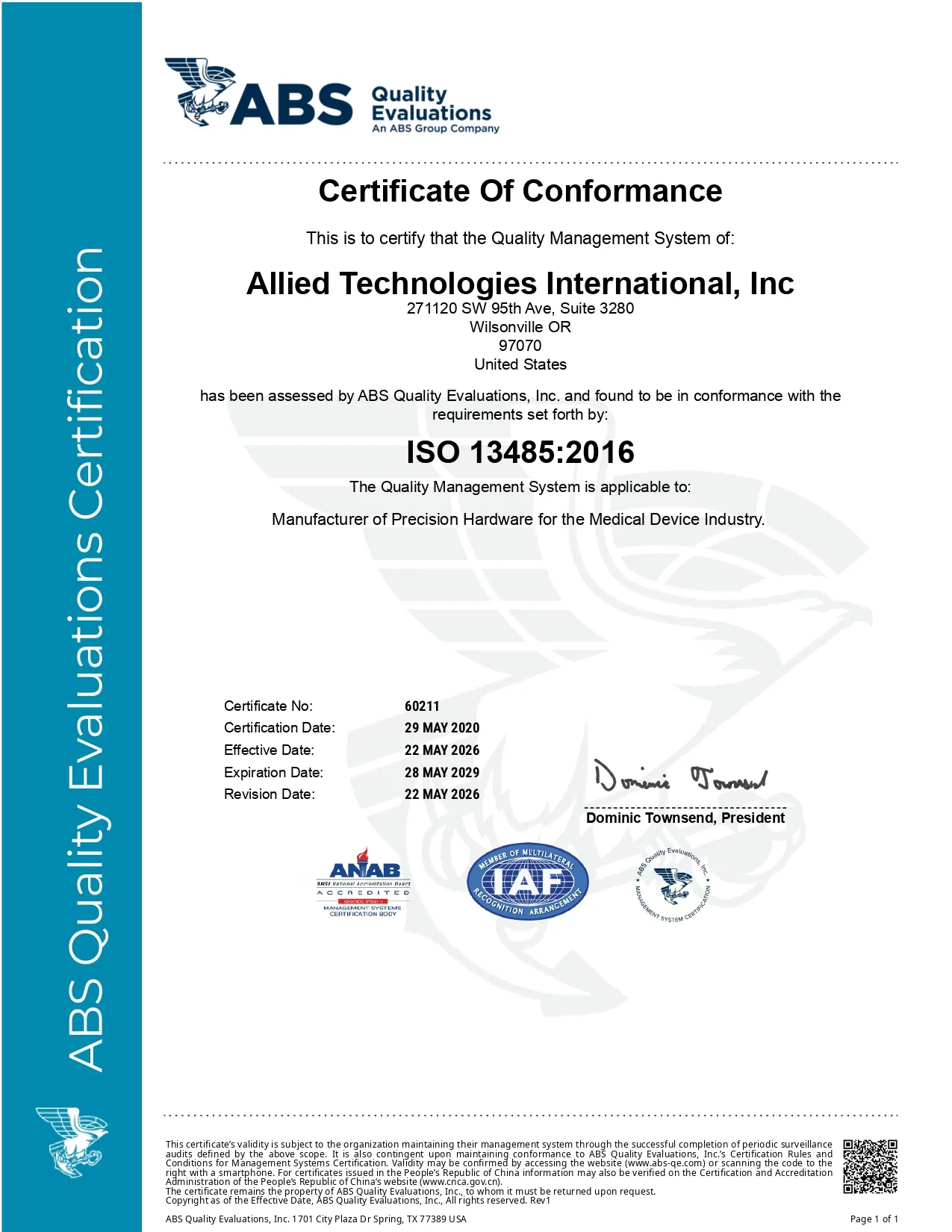
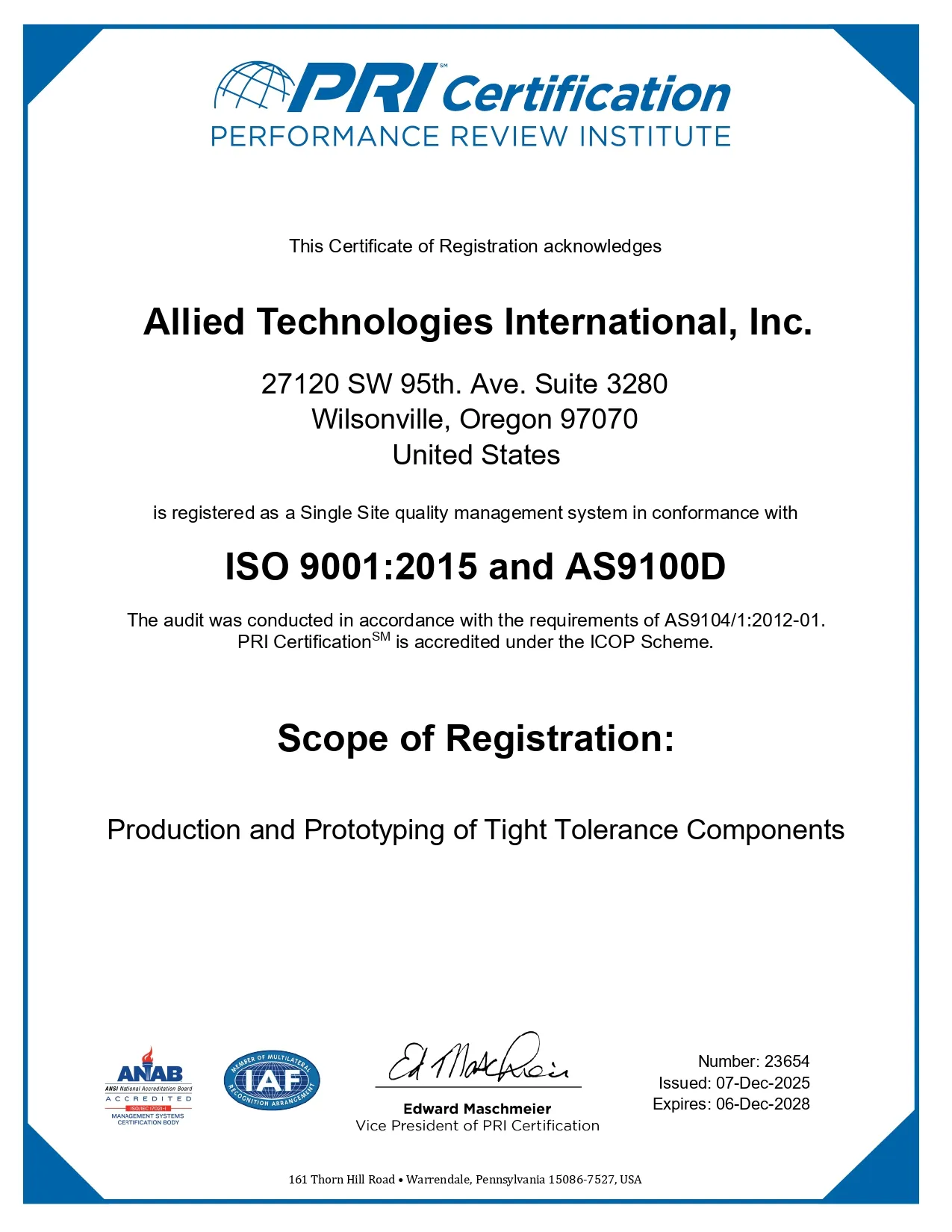
They also hold rigorous quality certifications like AS9100D for aerospace or ISO 13485 for medical devices. These are not just badges; they prove the shop maintains strict process controls.
Spotting Premium Quality in Swiss Machine Components
When a machine drill exits a hole (a cross-hole) or cuts a screw thread, the metal stretches slightly rather than snapping off perfectly clean. That leftover raised metal ridge is a burr. High-grade shops make sure those are entirely gone so they do not break off and jam a mechanism later.
These flawless details matter immensely when components are placed inside fluid power systems or medical electronics. Even a tiny metal burr breaking free inside a valve can cause total system failure.
Precision manufacturing is a game of microscopic details. Working with a vendor who masters these details gives you complete peace of mind when launching new products.
How Allied Technologies International Delivers Flawless Execution
When a single bad part can stall an entire assembly line or cause a catastrophic field failure, tolerances are not suggestions. They are absolutes. That is why we built our business around components that simply cannot fail.
From our machine shop in Wilsonville, Oregon, our team handles the heavy lifting for high-volume production runs and complex prototyping. We apply advanced Swiss-turned components suppliers’ processes directly on the shop floor to cut through stubborn materials like titanium, Inconel, and PEEK without losing dimensional accuracy.
We do not just talk about quality control; we back it up with hard certifications. Our facility is ITAR compliant, FDA registered, and certified to AS9100D and ISO 13485 standards. We know how to take a complex engineering print and turn it into a flawless, repeatable manufacturing reality.
Ready to bring your precision manufacturing project to life with tolerances that cannot fail?