Precision parts don’t fail loudly at first. They fail quietly, usually because something was off by a fraction nobody bothered to question. That’s the part most people underestimate in manufacturing until it actually costs time, money, or a full batch of work.
This is where CNC precision turning starts to matter in a real way. It’s not just about shaping metal, it’s about holding consistency at scale. Studies from manufacturing research groups show CNC processes can improve dimensional repeatability several times compared to manual machining, especially in tight-tolerance work. And when you start stacking complexity on top of that, those small gains in accuracy turn into the difference between a working system and a rejected part.
What Is CNC Precision Turning?
CNC precision turning is a machining process where a spinning material is shaped by a cutting tool that moves based on a programmed path. The machine is not reacting in real time. It is just following instructions that were defined before the cut even starts. Once that program is set, the same movements repeat every cycle. No variation, no interpretation, just the same cut done the same way again and again. That is where consistency actually comes from in production. In most real manufacturing setups, tolerances are usually around ±0.001 inches. In tighter applications, it can go further depending on tooling and material stability. That level of control is what separates general machining from precision work.
Why Accuracy Matters in Complex Components
Complex parts are not forgiving. There is no “close enough” when you are dealing with multiple features stacked into one component. You might have threads, grooves, internal cuts, and tight mating surfaces all in the same part. If one of those is off, the whole thing stops working the way it should. In industries like aerospace and medical, that kind of error is not acceptable. A small deviation can affect performance, safety, or how long the part lasts in real use. That is why precision is not just a requirement. It is the foundation.
How CNC Precision Turning Improves Accuracy
1. It removes human variation
Once the program is loaded, the machine does the same thing every cycle. There is no operator adjusting things mid-run or relying on feel. That matters more than people think. A lot of machining errors come from small human differences between shifts or setups. CNC removes that completely.
2. It holds tight tolerances consistently
CNC precision turning is built to stay within very tight limits. In stable setups, ±0.001 inches is normal, and in higher-end work, it can go even tighter. The key part is not hitting that number once. It is holding it across hundreds or thousands of parts without drifting. That repeatability is what makes it valuable in production environments.
3. Fewer setups mean fewer mistakes
Every time you move a part or reset it, you introduce risk. Even a small misalignment can affect final accuracy. Modern CNC turning centers reduce that by doing multiple operations in one setup. The less you touch the part, the less chance there is for things to go wrong. It is simple, but it works.
4. CNC Swiss machining handles the small, tricky stuff
When parts get really small or thin, regular turning starts to struggle. That is where CNC Swiss machining comes in. Instead of holding the material far from the cutting area, Swiss machines support it close to the tool. That reduces bending and vibration while cutting. The result is cleaner cuts and better control of small, detailed components that would otherwise be hard to machine accurately.
5. Material behavior stays under control
Different materials don’t behave the same way when you cut them. Some move more, some heat up faster, some resist cutting differently. CNC systems adjust cutting speed and feed rates based on those properties. That helps keep dimensions stable even when the material itself is trying to behave unpredictably.
Real accuracy improvements in practice
Compared to manual machining, CNC precision turning makes a noticeable difference. Manual processes can struggle to hold tight tolerances consistently, especially on complex geometries. CNC systems tighten that range significantly and, more importantly, keep it stable across production runs. That stability is really the main win. Not just precision, but repeatable precision.
Impact on production efficiency
When parts come out right the first time, everything downstream gets easier. Less rework. Less scrap. Less time spent checking and fixing issues. It also makes production schedules more predictable, which matters when you are running tight deadlines or large batches. Over time, that consistency usually ends up saving more than the upfront machining cost.
Understanding CNC precision turning cost
CNC precision turning costs can feel higher at the start compared to simpler machining methods. Setup, programming, and tooling all add to the initial expense. But that changes once production starts. When scrap rates drop and parts stop needing correction, the overall cost per usable part goes down. In higher volumes, that difference becomes even more noticeable. So it is less about the upfront price and more about total output efficiency.
Why this matters in modern manufacturing
Parts are getting more complex, and expectations are getting tighter. There is not much tolerance for inconsistency anymore. That is why CNC precision turning, especially when combined with CNC Swiss machining for smaller or more detailed parts, has become such a core part of modern manufacturing. It is not about making things fancy. It is about making them reliable at scale.
Choosing the right manufacturing partner
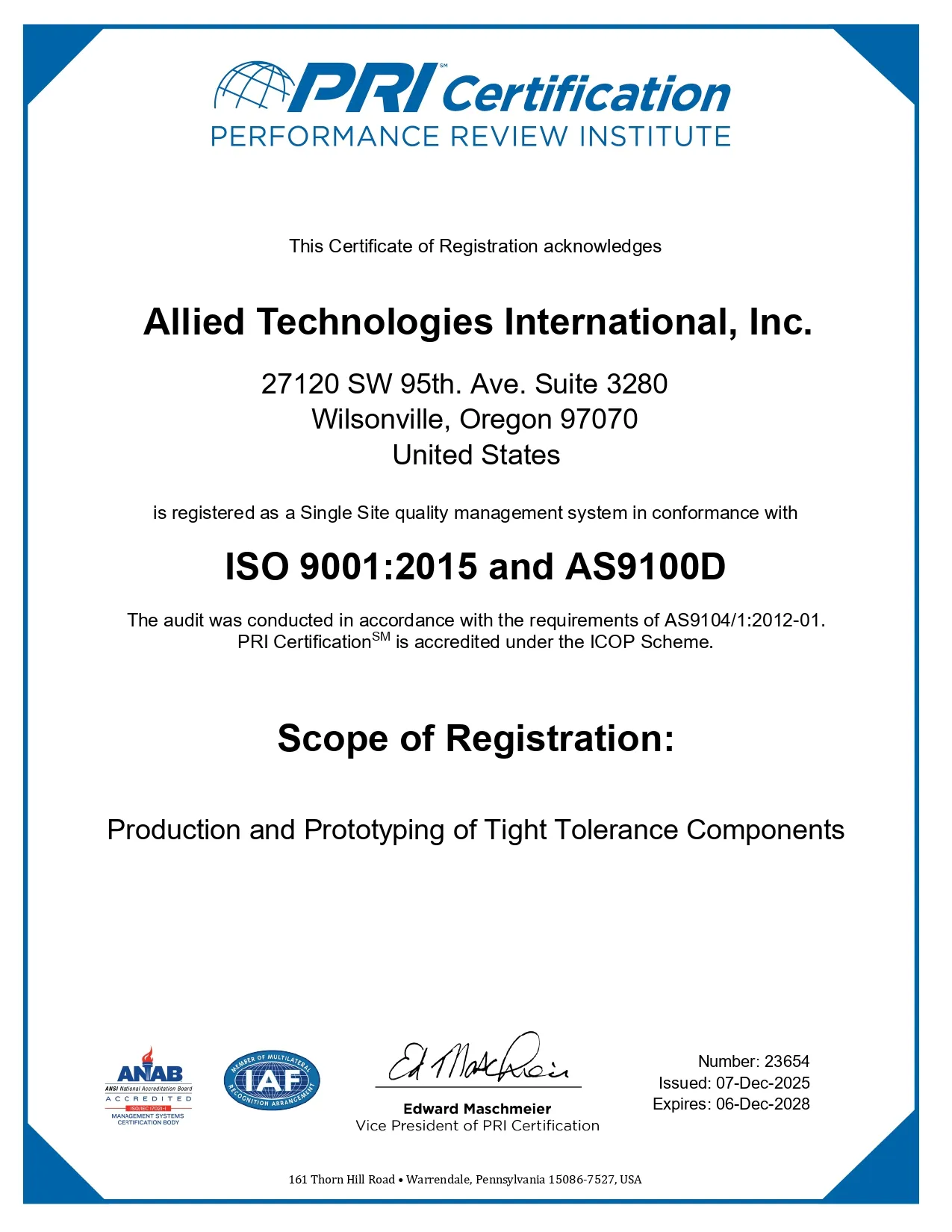
Not every shop works at the same level. Some are fine for general machining, others are built for tight precision work. A good CNC turning service provider is not just running machines. They are controlling consistency across every batch and every part. That is where experience and process control really show up. We at Allied Technologies International work in that higher-precision space, where every part has to stay consistent across batches, and nothing can drift out of spec.
Conclusion
At the end of the day, machining is not just about shaping metal. It is about making sure every part comes out the same, holds its dimensions, and actually works the way it was designed to. That level of consistency does not happen by accident; it comes from tight process control and repeatable accuracy.
CNC precision turning is what makes that possible. It keeps variation out of the process and holds steady even when parts get complex, or production scales up. That is what makes it so valuable in real manufacturing work. If you are dealing with tight tolerances and complex components, it is worth getting this part right from the start.