Skip to content
Need a part that is tiny, fragile, and hard to hold steady? Then you have probably heard about Swiss machining. It is not new, but people still treat it like a mystery. At Allied International Technologies, we run these lathes daily. We know what they do well, and where they fall short. Honesty matters here, because Swiss Machining Services in the USA are often oversold to buyers. So is Swiss machining always the right call for tricky parts? Sometimes yes. Sometimes no. This guide explains when it wins, when it loses, and how to choose without guessing.
What Makes a Swiss Lathe Different
A normal lathe grips the part in a chuck and spins it. The tool moves in to cut. A Swiss lathe works the other way. The bar slides through a guide bushing, and the headstock feeds it forward. Because the bushing supports the bar right where the tool cuts, bending nearly disappears. Thin, long parts stay straight. That is the core trick behind Swiss screw machining. It is also why the process still wins work.
Multiple tools can also cut at once. Turning, milling, drilling, and threading happen together. Fewer setups mean fewer chances for error. That matters when every micron counts. The idea came from Swiss watchmakers in the 1800s. They needed delicate parts machined without distortion. The sliding headstock solved it, and the principle still holds.
Where Swiss Turning Services Earn Their Keep
These machines earn their keep on compact, demanding work. Swiss Machining Services in the USA often shine in this zone. Most jobs sit under 32 mm in diameter.
- Long, skinny parts with a length-to-diameter ratio above 3 to 1. A standard lathe lets the middle of the bar sag under cutting pressure. The guide bushing holds the work steady, so the shape is true from one end to the other.
- Repeatable results across batches. Swiss machines earn respect for consistency, not just raw accuracy. The first part of the morning matches the last one at night.
- Detailed geometry in a single pass. Milling, drilling, turning, and threading all happen without moving the part between machines. Each feature stays locked to the same reference point, which removes a whole class of alignment problems.
- Difficult alloys and high-temperature metals. The extra rigidity lets tools bite harder without chatter, so tooling lasts longer.
- High volumes with lights-out operation. Bar-fed machining loads fresh stock automatically, so the machine keeps producing through the night. Operators check results in the morning instead of standing watch.
- Very thin wall sections. The bar is fully supported during the cut, so vibration stays low and surface finish improves.
- One source for the whole part. You receive a usable product, not a half-finished blank that needs another shop.
- Cleaner parts, fewer rejections. No time on carts or racks means no dents, no scratches, and no mix-ups with other jobs.
When Swiss Machining Is Not the Answer
Here is the honest part. Swiss machines are not magic. They are specialist tools, not universal ones.
Simple shapes do not need them. A plain bolt or simple pin turns fine on a standard CNC lathe, usually faster and cheaper. Bar diameter sets another limit. Most Swiss lathes are built for narrow stock, so bigger jobs need a conventional turning centre instead. Do not order Swiss for a one-off part either. The overhead only pays off when spread over many units.
High Precision Swiss Machining: Materials and Industries
Some industries cannot survive without this level of control. Swiss Machining Services in the USA have grown because regulators and engineers demand proof, not promises.
- This technique suits metals that fight back. Hard alloys need stable support under the cut, and the machine gives it.
- Swiss-turned components suppliers make the miniature threaded parts inside sensors, connectors, and valves. Some are no bigger than a fingernail.
- Design help before production. Good shops flag weak geometry early and suggest tweaks that make parts easier to machine. The changes never hurt how the part works.
- Aerospace precision components such as fittings and fasteners must hit strict standards. Swiss shops build that discipline into all runs, with paperwork to back it up.
- Medical devices rely on it as well. Implants and surgical tools need biocompatible materials and complete lot records, which Swiss machining delivers naturally.
- Electronics and telecom gear use Swiss machining for micro parts and housings. As devices shrink, these components keep getting smaller and more precise.
- Concentricity between features. The part remains round and true across all its diameters, which matters for press fits and sealing surfaces.
- Consistent pricing on repeat orders. Shops that track past jobs quote accurately, so your budget stays predictable from order to order.
High-Volume Precision Manufacturing: Cost and Lead Times
Volume changes the maths completely. The setup cost is a hurdle, but it shrinks with every extra part you run.
Once dialled in, a machine produces thousands of identical parts without rework. That is where the real economics take over.
Lead times shrink too. Because most work happens in one setup, parts skip the queue between machines.
Chip control deserves its own mention. Little parts create fine chips that can wrap around tools. Correct coolant and speeds keep the cut clean and the finish smooth.
Why Allied International Technologies?
We run Swiss lathes in our Oregon facility, backed by 3D simulation and strict inspection. Our Swiss machining services cover prototyping and full production runs. Engineers review each drawing before a tool touches metal. You talk straight to the people running your job, not a sales desk in another time zone. Questions get answers in hours, not weeks. No middlemen, no translation delays.
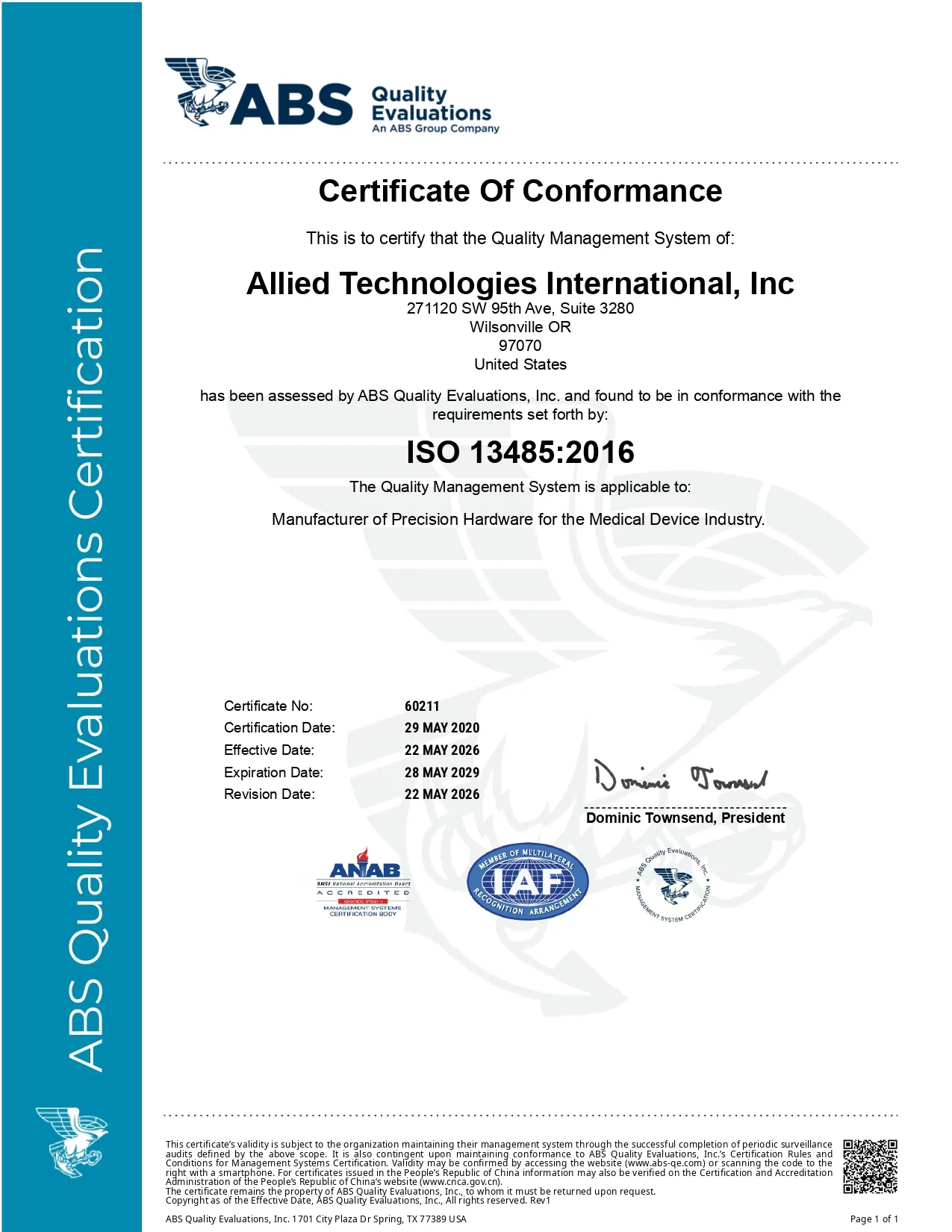
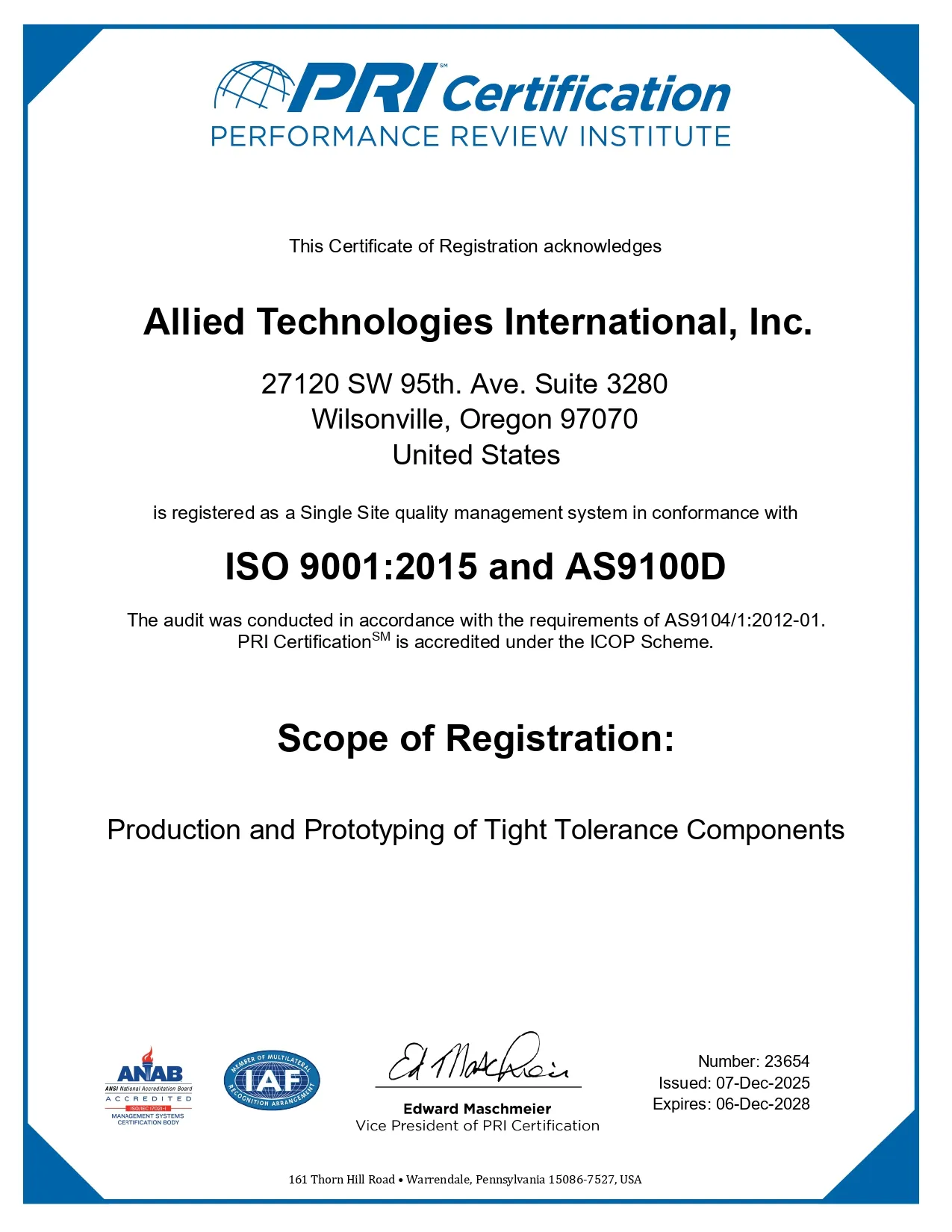
Documentation matters in regulated industries. Our company is AS9100D and ISO 13485 certified, with traceability on each batch. That is not paperwork for its own sake. It protects you in an audit. Think of us as the partner who tells you the truth. If Swiss Machining Services in the USA fit your project, we run them. If not, we say so.
Conclusion
So, is Swiss machining the best solution for complex components in the USA? For small, precise, high-volume parts, yes. For everything else, it depends. Talk to Allied International Technologies before you commit. We will look at what you are building, how many you need, and what it must cost. Then we recommend the right route, even when it is not Swiss. Swiss Machining Services in the USA are powerful when used well. Our job is to make sure you use them at the right time, on the right parts. That is how you get quality without waste.